International House of Journalists - Golden Sands

The botanical garden is the landmark of the International House of Journalists. It is an oasis of calm freshness, featuring a huge variety of plants, and is the perfect place for relaxation and recreation activities.
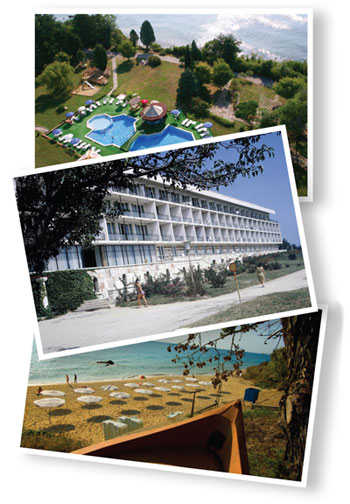
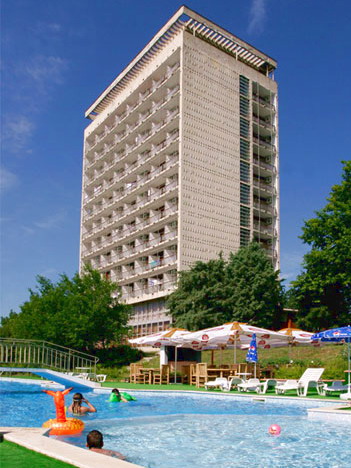
Nestled in 45 decares of splendid park, a few steps away from the white-sand beach, and only 10 kilometres far from the city of Varna, this complex is the perfect place for a romantic holiday in the Golden Sands area.

The complex hosts two hotels with total of 164 rooms and suits. All guestrooms are bright, comfortably furnished and feature variety of amenities such as large balconies, satellite TV, AC, phone, mini bar, high-speed Internet access, together with breathtaking sea view.

The International House of Journalists offers several dining options, ranging from the traditional restaurant in the complex to the fish restaurant situated on the beach. The Chinari restaurant, overlooking the park and the sea, accommodates more than 200 guests and prides itself with the most picturesque terrace in the area.
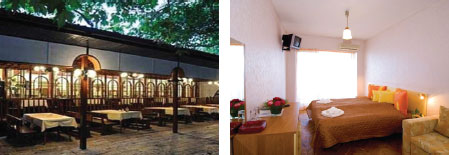
The Fish restaurant on the beach offers variety of delicious seafood meals complimented by an impressive wine list and full bar. One can chill out during the hot summer nights with freshly squeezed juices and drinks at the Lobby Bar terrace overlooking the charming courtyard or enjoy the perfect romantic escape in the Piano Bar.

Two well-equipped conference rooms, offering highly flexible solutions for 10 to 350 guests, are also available onsite for various events.

An open air swimming pool and the pool bar, a few steps away from the beach, are also available in the complex. Other amenities include free parking, children’s corner, laundry facilities, and free Internet access.

For contacts:
tel.: +359 2/ 9872808
e-mail: sbj_bg@mail.bg
sbj-bg.eu/hotelJurnalist/


Places to see nearby

Varna Necropol

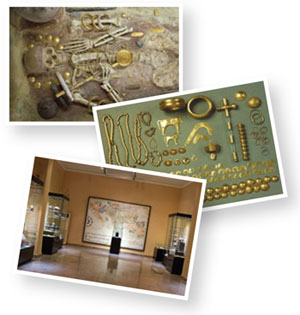
It is situated about 500 m to the north of the Varna Lake and about 4 km to the west of Varna. According to specialists, the findings are a part of eneolithic funeral, dating back to the IV century B.C. More than 294 tombs were found.

The 38 different types of golden objects, discovered in the examined tombs, are more than 3 000. Very large is also the quantity of finds of other materials – the copper articles are more than 160; the flint articles - more than 230; almost 90 made of stone and marble. Multiple shells of Mediterranean mollusca and about 1100 decorations made of them have been found. The ceramics – more than 650 clay pots, is an often found tomb inventory. The decoration on their surface is painted with golden paint.

The discoveries in the Varna Eneolithic Necropolis are the richest in Europe from the late eneolithic period. Experts describe them as “the world’s oldest gold” and a trace of “Europe’s most ancient civilization”. The treasure is currently exhibited in the halls of the Archaeological Museum in Varna.


Golden Sands Nature Park

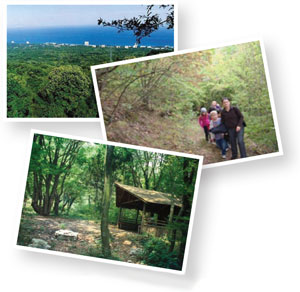
It covers an area of 13 200 square meters and is located 17 kilometres northeast of the sea capital Varna, along the seashore.

The park is a unique mixture of sea, greenery and a beautiful beach. The vertical limestone rocks, which figure the edge of the plateau, are very picturesque. Most of the park’s territory is covered with deciduous vegetation, mainly elms and oak trees. Dense forests cover the deep wet valleys, where 13 small natural lakes are situated.

More than 150 species of medical plants can be seen in the park. The fauna is represented by 621 invertebrate species, 11 reptile species, 122 bird species, 46 of which are continuously breeding and 40 are migratory, predatory, etc.; 27 small mammal species, 14 large mammal and bat species.


Aladzha Monastery

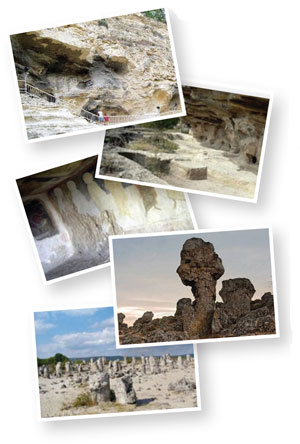
It is situated in a beautiful area 14 km north of Varna, in the centre of the Golden Sands Nature Park. There are no reliable historical records as to when the monastery was established, but there is evidence that it already existed in the 10th – 12th centuries.

The monastery premises are carved and arranged on two levels in a limestone rock that is almost 40 m high. The monastery church, the monastery cells, the refectory, the kitchen, the small cemetery church, the crypt (ossuary), and the farm premises are all situated on the first level.

The second level is a natural rock recess in the eastern part of which lies the monastery chapel. A group of caves known as the Catacombs is located about 600 – 700 m to the west of the monastery.

The archaeological finds such as pottery, coins, graffiti, etc., discovered there provide evidence that the Catacombs were inhabited by people during the early Christian Age (5th–6th C).


Pobiti Kamani (The Stone Forest)

The natural phenomenon consists of an ensemble of stone columns, up to 10 meters high, hollow or thick cylinders, crossed cones, variously shaped and sized rock blocks and multiple stone pieces, spilled around the entire complex.

For thousands of years the nature has carved stone pieces in order to turn them into impressive sculptures, which look like people, animals, monsters, mythical creatures, etc. “The Stone Guards”, “The Camel”, “The Throne”, “The Stone Forest” are names of just a part of these natural pieces of art.